
FOUNDER STORY
How I Started Growing Noisero with SEO Without Knowing SEO
I'm a solo founder, not an SEO expert. Here's how LUUMERA helped me build an organic search presence without hiring an agency or becoming a full-time marketer.
Building a product was the easy part. Getting people to discover it wasn't.
I built Noisero to solve a simple problem: removing background noise from audio and video without complicated editing software.
People search for solutions to this problem every day. They want to clean up a recording, remove wind noise from a video, improve podcast audio, or fix a voice recording.
So organic search seemed like an obvious growth channel.
There was just one problem: I wasn't an SEO expert.
I understood the basics. You need pages that answer people's questions, relevant keywords, and a website Google can discover. But knowing these principles and building an effective SEO strategy are two different things.
Which keywords should I target? What are competitors doing? What content is missing from my website? Should I write a new article or improve an existing page? How do I know what's worth doing first?
I could spend weeks researching all of this. But then who would build the product?
I didn't need another AI writer. I needed something that could figure out what to do.
My first instinct was to use AI to generate articles.
But writing an article isn't actually the hardest part of SEO anymore.
The harder questions come before and after:
- What should I write about?
- Is there real search demand?
- Which topics are already covered by competitors?
- What should I prioritize?
- How should different pages connect?
- How do I turn all of this into a consistent process?
I could ask ChatGPT each of these questions. But I would still be the person managing the operation, deciding what to trust, and connecting everything together.
That wasn't the business I wanted to run.
LUUMERA gave me an SEO workflow, not just content
I started using LUUMERA, an AI-powered SEO automation platform.
What appealed to me was that it approached SEO as a connected process, rather than a series of isolated tasks.
It analyzed my website.
LUUMERA examined Noisero's content and identified areas where the site could better address relevant search intents.
It researched competitors.
Instead of manually investigating competing websites, I could use competitor intelligence and competitor gap analysis to discover topics and opportunities worth exploring.
It helped me decide what to work on.
The research didn't end as a spreadsheet full of keywords. LUUMERA organized findings into SEO opportunities and a content plan, making it easier to understand what needed attention.
It created the content.
Once an opportunity was selected, LUUMERA could generate an article around the relevant search intent. I didn't have to write every tutorial, comparison, or supporting article myself.
It published to my website.
Through GitHub integration, LUUMERA could publish content directly into Noisero's codebase, removing much of the manual work between generating an article and making it available on the website.
And with internal linking capabilities, it also provides a way to identify relationships between pages as the content library grows.
The important part wasn't any single feature. It was having these activities connected.
What changed for Noisero
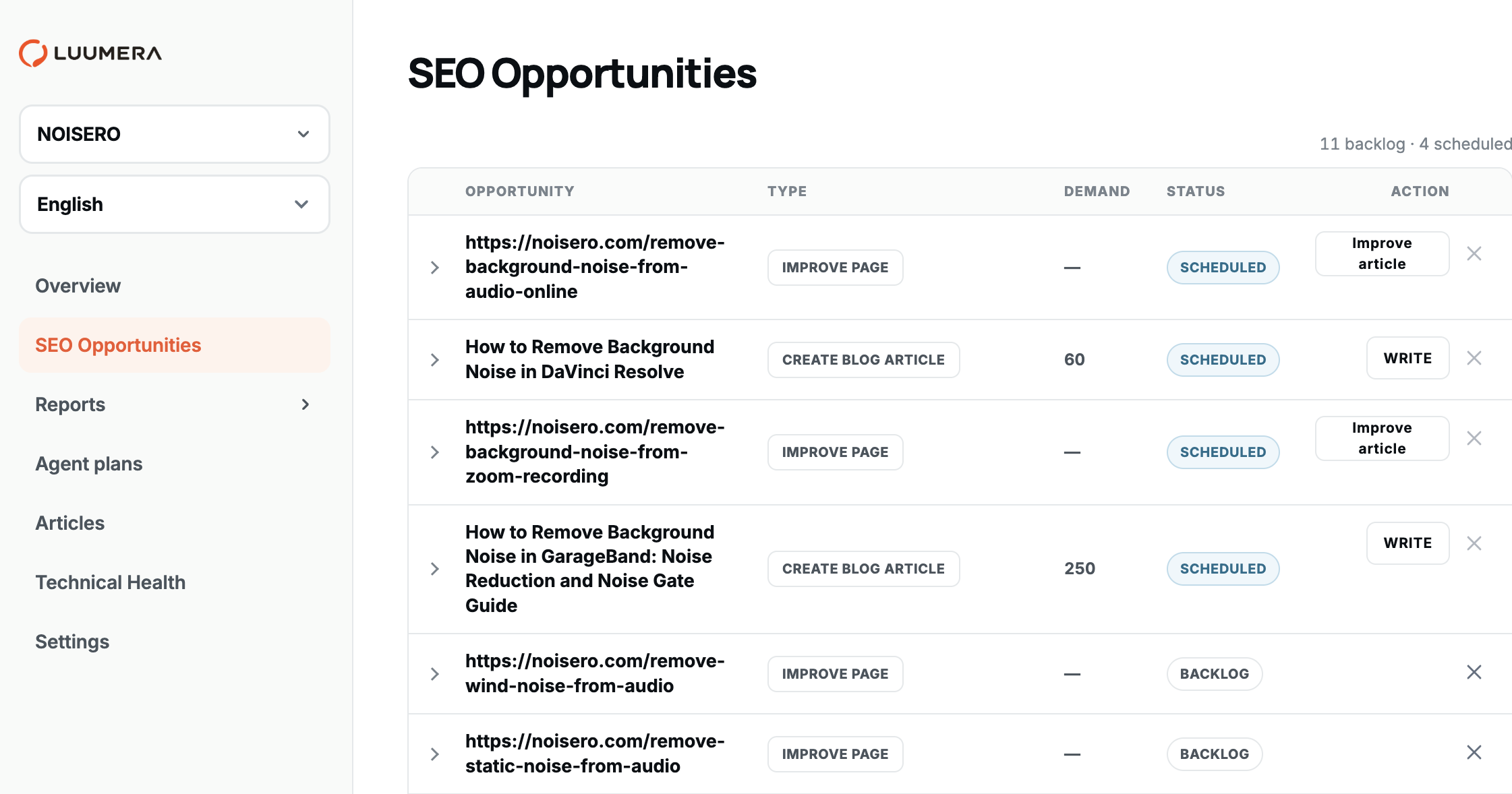
Instead of wondering which SEO task to do next, I had a clearer pipeline of opportunities and content work.
LUUMERA's research identified 96 SEO opportunities, including 19 from competitor gap analysis.
It helped generate articles around specific problems potential Noisero users were searching for, from removing background noise in CapCut to understanding how AI noise removal works.
And 11 articles were successfully published through its GitHub integration.
I still initiated some workflows manually, but I wasn't manually performing the underlying research, writing, and publishing work.
That distinction matters. For a solo founder, pressing a button to start an SEO workflow is very different from spending an afternoon doing the work yourself.
The first search results started appearing
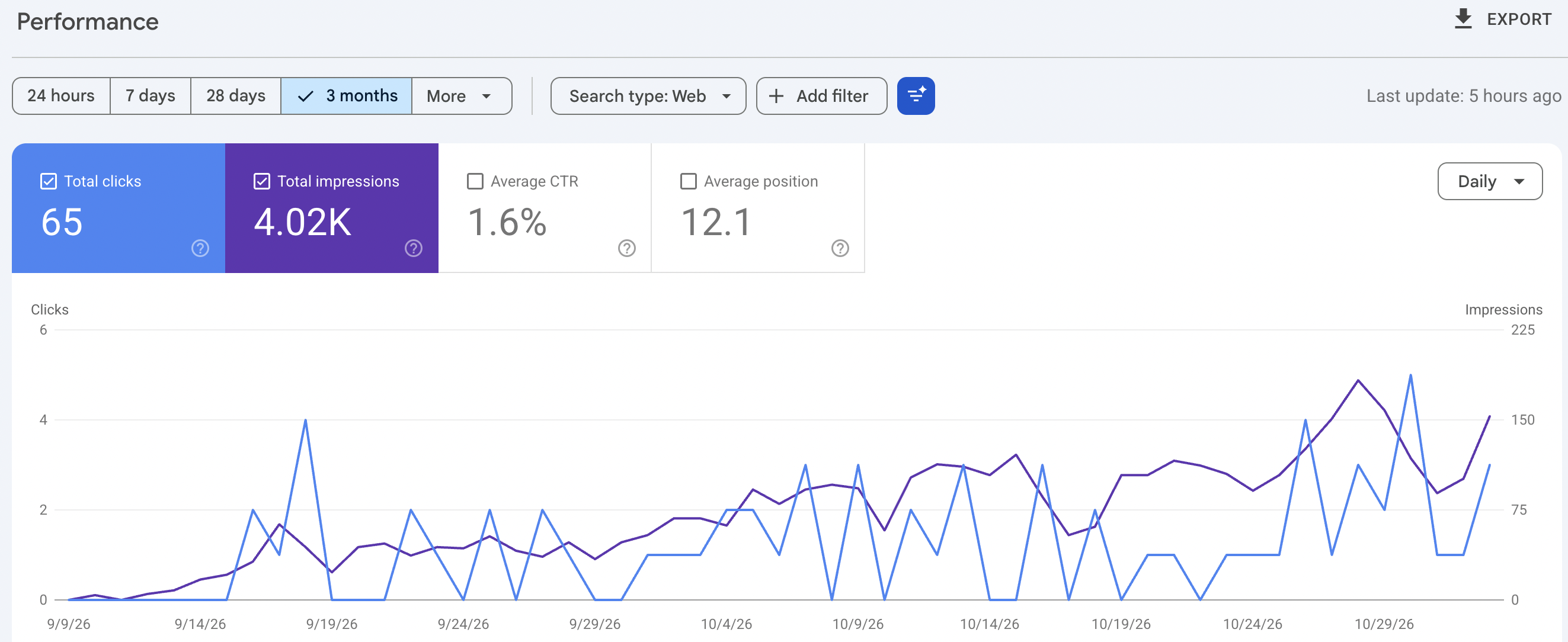
Over the early measurement period, Google Search Console recorded:
- 4,020 Google Search impressions
- 65 organic clicks
- 241 impressions in Google's generative AI search features
These are small numbers compared with established websites. And the overall growth cannot be attributed to a single tool or action.
But Noisero was developing a real presence in organic search while I continued focusing on the product.
For me, that was important progress: SEO was no longer something I had to constantly figure out and execute from scratch.
The biggest benefit wasn't the traffic. It was being able to focus.
There are plenty of tools that help you write content faster.
What I needed was something different.
I needed a way to handle SEO without becoming the person responsible for researching every keyword, interpreting every competitor, preparing every brief, and publishing every article.
LUUMERA helped me move from scattered SEO tasks to a much more structured process.
It hasn't turned Noisero into a massive organic traffic business overnight. SEO doesn't work that way.
But it has made building an organic search channel far more manageable for a solo founder.
And that's exactly what I needed.
If you're building a product on your own and SEO keeps falling to the bottom of your to-do list, take a look at LUUMERA.